
The Whistleblower Gap: Owning Your Internal Reporting Architecture
The NCUA encourages credit union employees to use its Fraud Hotline. Discover why relying on an external regulator is a governance failure, and how boards must own their internal whistleblower architecture.


The NCUA recently issued guidance emphasizing the critical role whistleblowers play in identifying and preventing insider fraud. The regulator correctly points out that employees are uniquely positioned to spot behavioral red flags, such as ignored security protocols, unusual working hours, or sudden unexplained financial pressures. To facilitate reporting, the NCUA encourages credit union staff to utilize its external Fraud Hotline.
While an external regulatory hotline serves as a necessary safety net for egregious or collusive fraud, it must represent a last resort. Relying on the NCUA to field internal staff concerns indicates a structural failure in your own governance framework.
A resilient credit union board takes absolute ownership of its internal reporting mechanisms.
The "Speak Up" Culture Mandate
In our Living System framework, fostering a secure reporting environment is categorized as a modern governance mandate. Unethical or illegal practices by leadership violate stakeholder rights and pose a severe reputational risk to the credit union. To mitigate this risk, boards must establish and fiercely protect a confidential whistleblowing architecture.
This requirement extends well beyond a generic "open door policy". A true whistleblowing architecture provides a structured, secure pathway for the escalation of critical information.
Direct and Independent Access
Employees must have the ability to report concerns regarding unethical behavior directly to an independent resource. This could be the Supervisory Committee, an external ombudsman, or a designated third-party reporting system.
The defining characteristic of this pathway is safety. Staff must be able to report concerns—either personally or through a representative—without fear of retribution. The board's responsibility is to ensure these safe-harbors are explicitly documented, consistently communicated to all levels of staff, and rigidly enforced.
The Governance Takeaway
If an employee feels compelled to call the NCUA to report an internal issue, your credit union has lost the opportunity to identify, contain, and resolve the problem proactively. Governance is about maintaining institutional trust and member confidence. A well-architected internal reporting process ensures you uncover vulnerabilities early, protecting both your employees and your cooperative.
If your board needs to move beyond outdated policies and build a proactive, auditable governance framework, contact us today to discuss our strategic governance workshops. You can also explore these concepts deeply by downloading the second edition of our Living System ebook.
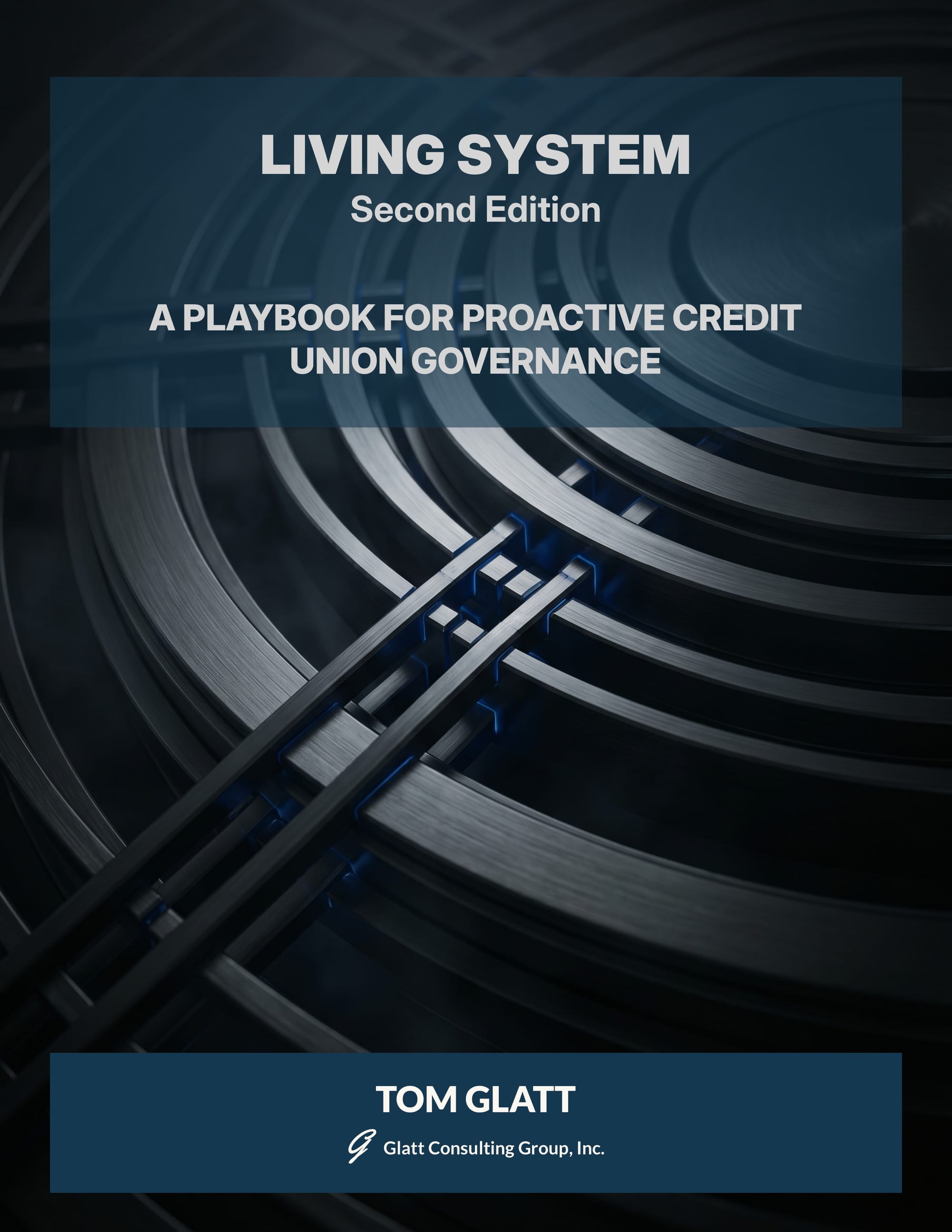
Download the Living System Playbook
The Living System Playbook details our complete methodology for proactive credit union governance. It provides the exact mechanics required to transition from a static "binder on the shelf" to a dynamic, auditable framework that protects the institution and empowers your CEO to execute with velocity.
Access the full Living System methodology free in our executive Resource Library.