
Stress-Testing Your Business Model: How to Leverage Scenarios
Learn how to implement a "Strategic Wind Tunnel" to stress-test your credit union's operations against high-impact scenarios and build a resilient planning process.


For decades, traditional strategic planning has relied on a dangerous assumption: that the future will behave exactly as forecasted. Today’s credit union executives operate in a highly volatile environment where economic shifts, technological disruptions, and regulatory changes occur rapidly. To survive, a credit union must transition from a static plan to a dynamic, living strategy. This requires moving beyond standard financial projections and actively testing your institution's structural integrity. In our Living Strategy methodology, we call this the "Strategic Wind Tunnel"—a structured process to expose your business model to hypothetical disruptions before they become a reality.
Phase 1: Filtering Disruptions with the PESTLE Radar Sweep
Stress-testing a business model begins by systematically scanning the external operating environment across six categories: Political, Economic, Social, Technological, Legal, and Environmental (PESTLE). Once potential threats are identified, the leadership team evaluates each item collaboratively on two axes: probability of occurrence and severity of impact.
To execute a meaningful stress test, executive teams must isolate Low-Probability, High-Impact events. Threats that are both highly probable and highly impactful represent current operational realities that require immediate remediation rather than hypothetical scenario modeling. By focusing scenario planning on severe, low-probability "Black Swan" events, the organization creates a controlled environment to evaluate structural resilience without getting bogged down by daily operational noise.
Phase 2: Subjecting the Business Model Canvas to Scenario Wind Tunnels
With the target scenarios selected, leadership subjects the Current-State Business Model Canvas (BMC) to the simulated conditions of each disruption. This step systematically evaluates both hemispheres of the canvas to identify operational break points and strategic leverage opportunities:
- Left-Hemisphere Testing (Operational Capability): Evaluate how the scenario impacts internal machinery. Assess whether current Key Resources (such as legacy technology or balance sheet liquidity) fail under pressure, or whether key vendor partnerships become operational liabilities. Determine where cost structures become unsustainable if transaction volume or margin shrinks.
- Right-Hemisphere Testing (Strategic Relevance): Evaluate whether the core Value Proposition remains compelling to target Member Segments during the disruption. Determine if delivery Channels remain functional and whether member relationship models hold up under stress.
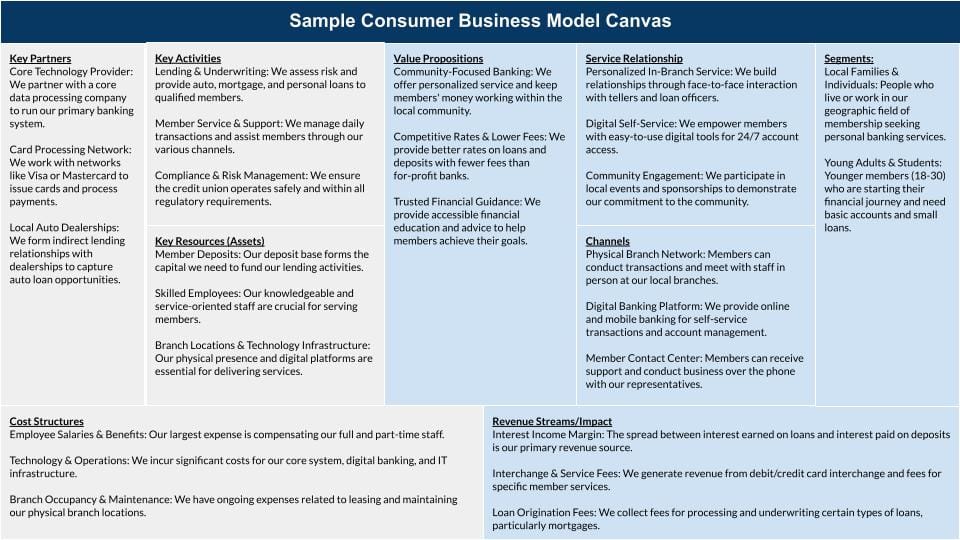
This process exposes structural vulnerabilities—such as rigid vendor contracts or narrow demographic reliance—while identifying underutilized operational assets that can be repurposed to capture emerging opportunities.
Actionable Implementation Guidance
Executive teams introducing scenario stress-testing into their planning cycle can apply the following structural steps to execute the process:
- If the board and executive team struggle to objectively agree on the severity or likelihood of external threats during the PESTLE phase, then consider deploying an independent, blind voting survey prior to the planning session to prevent dominant personalities from skewing the risk baseline.
- If the organization's governance calendar does not permit a full scenario planning exercise during standard quarterly meetings, then consider dedicating the primary annual strategic retreat exclusively to identifying Black Swans and running the deep-dive wind tunnel exercises.
- If your credit union does not currently utilize the Business Model Canvas framework, then consider applying the wind tunnel questions against a strict, documented inventory of your mission statement, top three revenue streams, core operating platforms, and primary member demographics to identify points of failure.
To explore the complete methodology for stress-testing your business model and building an adaptive strategic framework, download our Living Strategy playbook.
Access the full Living Strategy methodology free in our executive Resource Library.